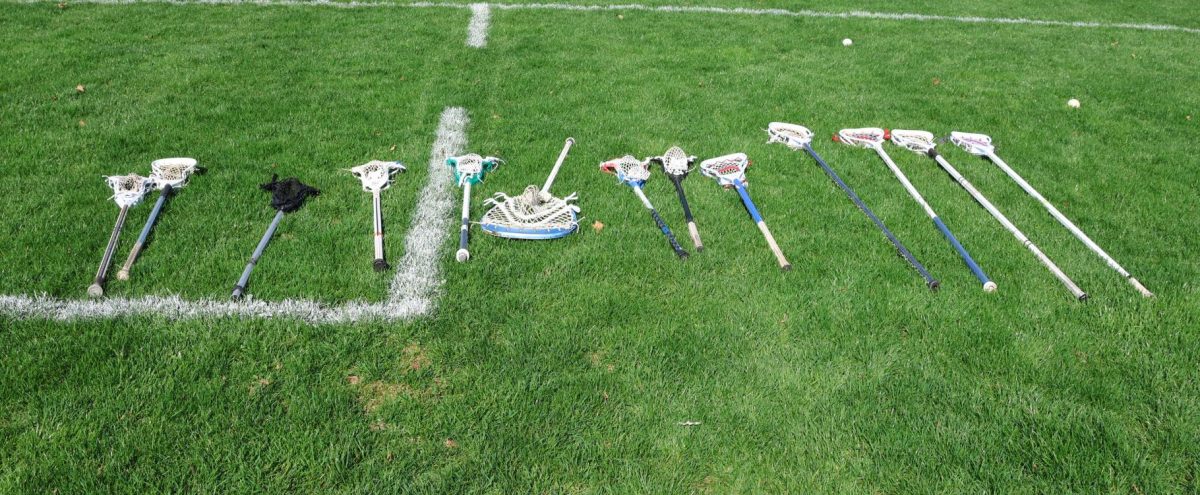
The day sophomore Emerson Dodge tore her ACL at the varsity lacrosse game during her freshman year, she said she was already in a bad mood, so she “kinda knew something bad was gonna happen.”
The team had just scored a goal, so they continued the game with a “draw” which is a girls version of a “face-off.” As a midfielder, Dodge’s job was to try to get the ball from the players in what is called the “draw circle.” The ball went to her left, and when a girl on the other team chased after it, Dodge ran after her.
“I must have hit a divot in the field when I was running,” Dodge said, “and then my foot planted on the ground. I heard a pop in my knee and I felt it go in and then I fell to the ground and it hurt really bad.”
Dodge had torn her ACL, which meant she would not only be out for the season, but would also not be able to play soccer or basketball during her sophomore year.

But she didn’t know that yet.
The fear of what just happened washed over Dodge as she knew immediately what happened, but was in denial. As she had never been seriously injured before this, she was scared because she was unable to even walk.
“It was mostly just me waiting and waiting and waiting,” Dodge said. “Then I found out that I fully tore my ACL in science class. I started bawling my eyes out. I was so sad.”
Her physical health wasn’t the only thing affected with the injury, her mental health had a “lot of ups and downs.” This led her to feel dependent on other people despite being someone who is used to being independent.
“I had to have surgery, so that was like a really low point,” Dodge said. “I couldn’t do anything for myself and I just couldn’t really live my normal life. It felt so weird because I was physically fine. I’m a young person but it literally felt like I just couldn’t do anything.”
Even after undergoing months of physical therapy, surgery and struggles, she said she is still not where she wants to be. The feeling of wanting to be better follows Dodge as she continues PT and tries to get back into normal and simple physical activities.
When she first got hurt, she said she would give herself “a little bit of credit” because she “couldn’t really do anything.”
But even though she keeps improving, she has become more frustrated with what she still can’t do.
“The other day at physical therapy,” Dodge said, “I couldn’t do one of my exercises because my leg hurt, and I just felt more upset at myself.”
She said it is difficult to have worked so hard, but is still struggling to do some of the activities she used to be able to do.
“Why can’t I do this?” Dodge said. “I’ve been able to do it before, why can’t I do it now?”
Even though she gets frustrated, Dodge has come a long way.
After her injury, Dodge had to relearn to walk, regain strength in her leg, and adapt to life on crutches until she was able to walk alone.
While she went through that rough time, she lost the feeling of independence, faced hard situations, and had to lean on her family and friends.
“Everyone has just been really supportive,” Dodge said. “My family especially. Obviously, they have no idea what I’m going through, but they try as hard as they can to understand why I may act the way I do sometimes.”
Her friends were also supportive, “especially right after surgery,” she said.
Her teammate junior Summer Butler was one of those people who supported Dodge. She said she admires Dodge’s dedication.
“Even when her injury takes a toll on her,” Butler said, “she still shows up to everything. It feels as though nothing ever happened because she’s still a part of the team and is always with us.”
Overall, Dodge said she had “a really supportive” group of people around her.
Dodge’s advice to others going through the same thing is to not have “any expectations about what it’s gonna be like.”
“Obviously, there are people who have gone through the same thing who give you advice,” Dodge said. “But, no one’s recovery is gonna be the same.”
Different people will have different reactions depending on the severity of the injury and how much support the person has, she said.
“Someone can’t tell you when it’s gonna be good and when it’s gonna be bad,” Dodge said. “You just kind of have to go into it knowing that your life is gonna change.”