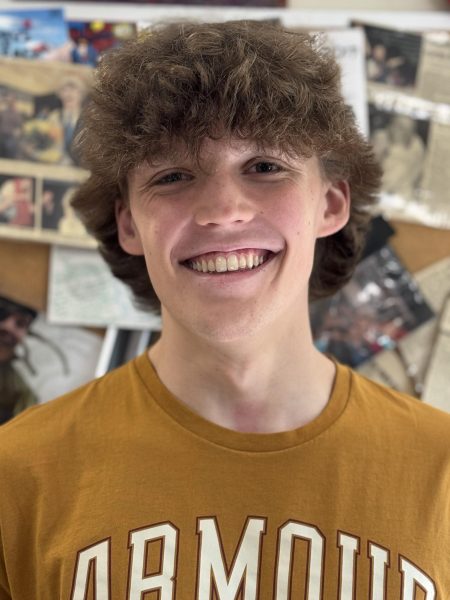
On most mornings, history teacher Peter Willis is already on his feet before the bell rings, moving between desks, asking questions that sound casual but land with intention.
History, in his classroom, is never just about dates on a timeline; it is about moments. The small, ordinary ones that quietly shape who students become long after they leave the classroom.
After 40 years of teaching classes like AP U.S. History, humanities and world history, Willis has learned that impact is not built through perfectly polished lessons or from rigidly following a curriculum.
Instead, it grows through presence, curiosity and a willingness to learn alongside his students. From mentoring colleagues to helping students see their place in the wider world, Willis has refined a teaching philosophy rooted in human connection, one moment at a time.

“Forevers are built from moments,” Willis said. “When a student asks for a recommendation letter, when you get a thank-you note or when they give you a little care package at the holidays. I don’t ask for things, but all those little moments matter.”
Willis did not always know that history would become his life’s work, but he knew early on that school mattered to him. Growing up in a rural area, he saw the classroom as something more than a place to learn.
“School was where everything was happening,” Willis said. “It was where the ideas were, it was where the interaction was, and it was my gateway to a bigger world. I always liked that idea, and I wanted to be a part of it.”
Throughout different parts of his life, he imagined different paths for himself. In grade school, he wanted to be a dentist. But by high school, teaching had become the only future he could picture, he just wasn’t looking towards history quite yet.
“I thought originally I was going to be an English major, teaching English,” Willis said. “The history, social studies and social science departments where I went to school were so strong that I thought ‘this is where I want to be.’”
As he began his career, Willis described his teaching philosophy as “clueless.” Early on, he believed success meant doing everything the same, normal way, but over time, experience taught him otherwise.
“You start out like that thinking that you need to do everything by the book,” Willis said, “and then over time, you think less of ‘Okay I’ve got to do right by the book,’ and you’ve got to do right by the people you’re in the room with.”
That shift, he said, was his turning point, the moment he began

experimenting, adjusting and trusting his instincts.
“So, in a way, you start out clueless and through experience, you start to get clues,” Willis said. “But you’re never gonna quite solve the mystery, and that’s the trick. I think I’m always trying to solve the mystery. And I know I’m never gonna get there, but boy, the ride’s going to be fun.”
At the center of that mystery is engagement. Willis believes that if he is not invested, no one else will be.
“If I’m not engaged, if I’m not enjoying being here,” he said, “how the heck are students, or my colleagues, or anybody else, how are they going to engage if I don’t?”
Willis measures success less by test scores and more by subtle changes he sees in students day to day. He hopes that each class leaves students slightly more curious than when they arrived.
“That’s what we’re about,” Willis said. “We want to give students a chance. Here’s a chance; take it, get smarter, be a better thinker, be a better listener, be a better person.”
While Willis has coached and advised clubs over the years, he believes his greatest contribution outside the classroom is simply showing up.
“In general, it’s being here,” he said. “Just being present so that if somebody needs help with something, somebody’s looking for a resource of some kind, or somebody needs some help planning something.”
That presence has made a lasting impression on fellow teachers, including social studies teacher Susan Wakelin, who worked across the hall from Willis since early in her career.

“He was my mentor,” Wakelin said, “and I think it was at that point that I realized just how brilliant of a teacher he really is.”
Over time, their professional relationship grew into a close friendship. Wakelin said Willis is someone she can turn to for both teaching advice and life conversations, noting that his kindness often goes unnoticed.
In the classroom, Wakelin said, Willis’s humor and wit help students connect to challenging material.
“I think he tries to do something to hook the kids first to get them thinking about what they are interested in,” Wakelin said, “and then he shows how that relates to what he’s teaching.”
What impresses her most, however, is his willingness to continue learning, even after many years in the profession. She pointed to his recent work experimenting with artificial intelligence in lessons, calling him “a renaissance man.”
“For the number of years that he’s been teaching, he is always willing to be a learner as well,” Wakelin said.
For those considering a career in teaching, Willis offers practical and honest advice. He warns that the job is physically demanding, requiring constant movement and attention.
“If you’re not up presenting, moving among people, being in that moment, you don’t realize how physically demanding it can be,” Willis said.
The mental load, he added, is just as intense.

“We make more decisions in the course of a typical workday than neurosurgeons,” Willis said.
“We’ve got anywhere from twenty to thirty people, all of whom are coming in with their own situations, their own concerns, their own agendas. We’re trying to stitch that all together.”
That mindset is what Willis lives by.
“If I help students see that they could have a better chance, then that’s par for the course,” Willis said. “I hope that somebody walks out of my room every day feeling a little bit smarter, a little bit more in touch with the world and a little more engaged than when they started.”