


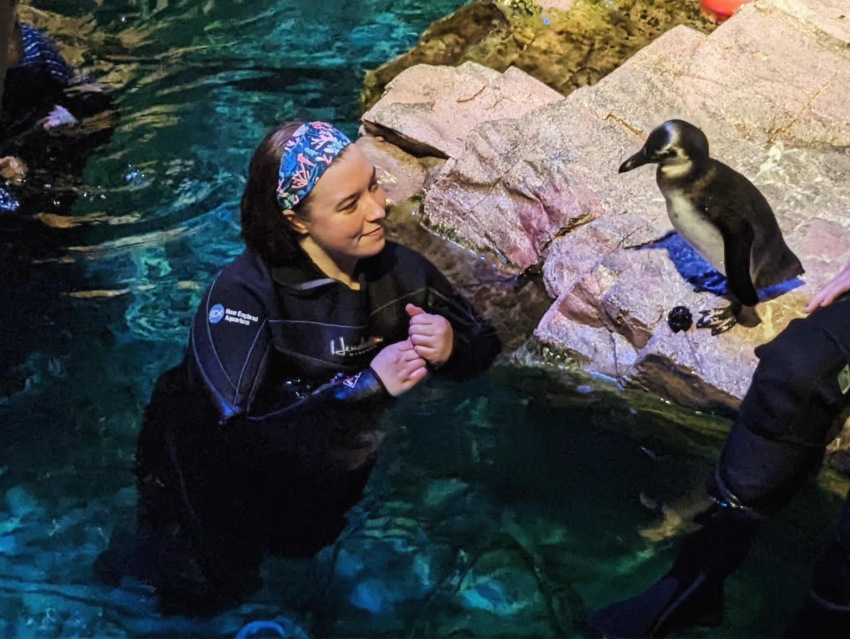
The hum of the filtration pump fills the air as sunlight shines across the wide ocean tank, casting ripples of all shades across the floor. Penguins chirp and honk as they waddle across the rocky exhibit. The grunts of harbor seals from the outdoor exhibit can be heard as visitors walk through the entrance.
In the middle of it all stands Amanda Claussen — a biology teacher during the weekdays, and a New England Aquarium volunteer on the weekends. But an educator? Always.
Claussen’s marine journey started in college, when she began working in veterinary medicine at a surgical center. She later applied for internships at the New England Aquarium and qualified for a volunteer role at the aquarium’s medical center, which she worked at on weekends.
“I didn’t know anything about treating fish or penguins or turtles at that point yet,” Claussen said, “so I wanted to see if getting into more exotics would be something I’d be interested in.”
While Claussen “loved” her work at the surgical center, there was a downside to it.
“It was a really hard job with some really rough people, but going to the aquarium at the end of the week made all of it go away,” she said.
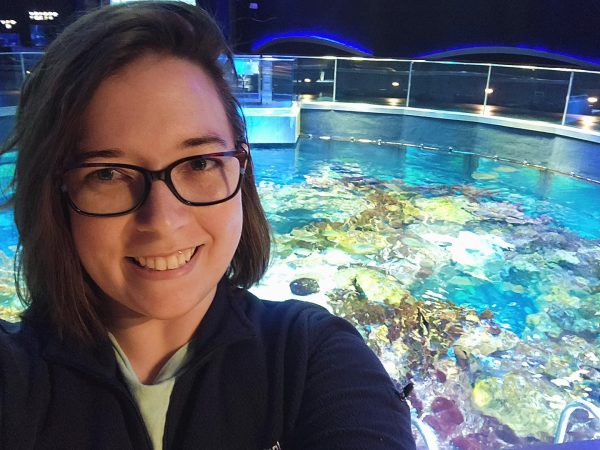
Since she started volunteering at the aquarium, Claussen has worked with animals across the animal kingdom, even across the world.
“Mostly we’re working with thousands of different species of fish,” she said, “but the one [species other than fish] I most frequently interact with would probably be the African penguins.”
In order to combat the endangerment of various aquatic species, the aquarium does everything it can to educate others.
During educational talks, there is a speaker who answers questions about the animals. They present about the giant ocean tank and talk about Myrtle, the green sea turtle, or they will talk about the seals.
“It is entertaining, but it’s also enriching for the animals as well,” Claussen said.
Although Claussen had previously worked with many animals, her volunteering job has helped her learn a lot about aquatic animals.
“I’ve gotten very good at dissecting fish because usually anything that dies in the aquarium will undergo a necropsy to see if there are any parasites,” Claussen said. “If there’s any cancer or anything weird going on that we should know about, it helps us with research.”
Claussen has also learned not only how to help fish, but also other animals in the aquarium, as well.
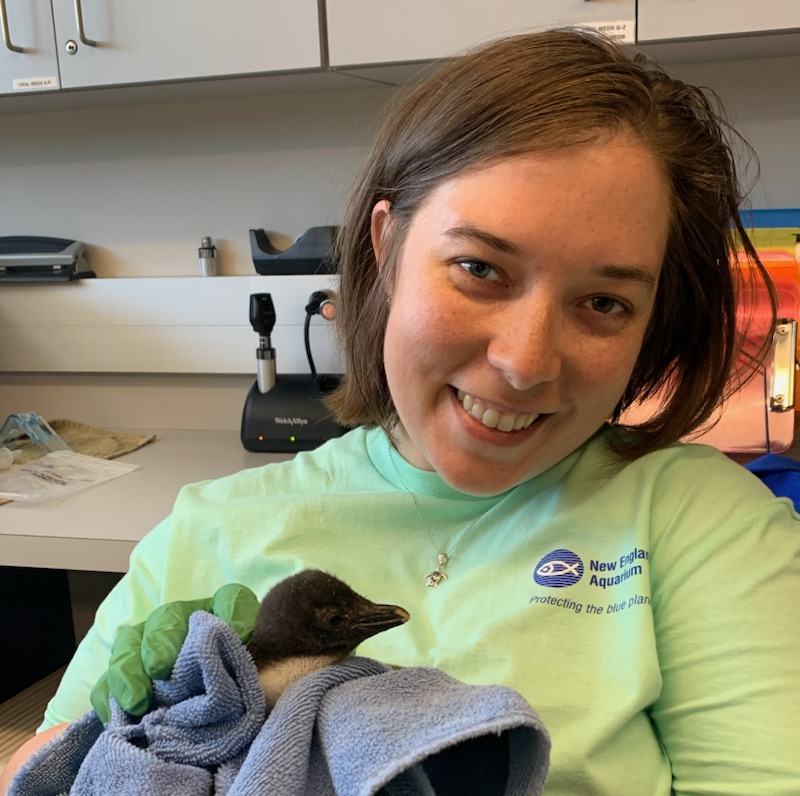
“I can breathe for a penguin while it’s under anesthesia,” she said. “We use this bag to kind of put the gas down their trachea to keep them under anesthesia, which is definitely very different from treating any dog or cat, for example.”

No matter what size or species the animal is, Claussen said that she always wants help with any issue or medical problem.
“We will do whatever we can for the smallest animal,” she said. “I’ve treated fish that are an inch long, and we do whatever we can to treat them.”
Nina Nahvi, the hospital manager at the New England Aquarium, said that the medical team of veterinarians is “extremely extensive.” Nahvi said that Claussen is a “hardworking and dedicated” member of the team.
“She seeks out opportunities to help others, such as checking in with other teams to see if they need help,” Nahvi said. “Amanda’s contribution to our team is fundamental to our ability to properly care for so many animals every day. Amanda is an incredible, dedicated volunteer, and we are so lucky to continue to have her volunteer with us after all these years.”
Nahvi said the job requires flexibility in every area, not just one. For fish, the team uses a water table that sends anesthetized water over their gills so they can keep breathing.
“They’re getting oxygenated and anesthetized,” Claussen said, “but people don’t think about fish going under anesthesia as your dog or cat would.”
Despite the “serious medical work,” Claussen said she values time with the many species and seeing the public interact with the animals.

“I love when kids ask me questions,” Claussen said. “It’s always fun if I’m up feeding Myrtle, the giant green sea turtle, and all the kids ask about her. And I love it when I know the answer.”
Claussen had the chance to interact with and aid one of the African penguins. The aquarium used to have a penguin named Beach Donkey. She had photodermatitis, which is a foot lesion that penguins often get.
“So, we made her little boots,” Claussen said. “We would go on field trips with her, and just walk her around the aquarium before it opened, and that was always fun.”
Despite how “fun” working with the wide variety of animals at the aquarium is, Claussen said that the “challenging” part of the job is when the animals die.
“It doesn’t happen super frequently,” Claussen said. “Unfortunately, you get kind of numb to it, though. When it’s an animal that is more notable and has a name and a personality, that’s really hard.”
For Claussen, the choices about when euthanasia should be used are a “difficult, hard decision as well.” The team discusses the animal’s quality of life when making decisions about euthanizing an animal. Since the aquarists work with their their animals everyday and know them best since, the vets discuss the answers to these questions with them:
Is the animal comfortable? Is it in pain? Is the issue treatable? Does the animal have the ability to perform natural behaviors? Can it navigate its exhibit normally, free of pain?
“Ultimately, it is up to our veterinarians to make the call regarding euthanasia,” Nahvi said, “and it is never a decision made lightly.”
However, despite the hard decisions the medical team has to make, Claussen said there are many positive aspects of her volunteering job that make it worth it.
“The most rewarding thing is just getting to have the experiences,” Claussen said. “Not every Saturday is exciting. Sometimes it’s just cleaning and reorganizing things, and that’s fine. But just getting to be there is great, and the people I work with are really amazing.”
For those who are looking to volunteer at an aquarium, Claussen said it is “worth applying.” She added that, no matter the role, cleaning is part of the job, and volunteers get to work with many different people.
“Everyone [at the aquarium] is very like-minded, and they’re there for the animals,” Claussen said, “so it’s very easy to get along with people.”
That shared passion for the animals makes the experience “rewarding” for everyone involved.
“Ultimately, the aquarium became my happy place,” Claussen said.







gracemcelroy
Mar 4, 2026 at 10:02 pm
such a cool story!