

A Close Call With Vaping
A faint cloud of sweet-smelling vapor rises from behind a black metal storage cabinet, disappearing almost instantly into the air. That small, fleeting puff nearly got Graham Leary* caught during his freshman year health class.
The substitute teacher rose from his desk and began approaching Leary to check on him. As the footsteps grew louder, Leary shoved the vape into his pocket. Leary lowered his head, and the substitute paused beside him for a moment. Thinking he was dozing off, the teacher nudged him and chuckled. Leary let out a fake laugh to play along; however, that close call did not stop him.
“Curiosity got me into vaping,” Leary said. “I vaped to relax, and I did it sometimes, not every day, though. I’d tell someone new to vaping to be careful. Don’t get caught by teachers or parents. It’s easier than you think.”
When Leary first started, he would vape frequently, but as he grew older, Leary claims that his vaping habits became less frequent.
“I haven’t had trouble cutting back,” Leary said. “The key is not doing it daily, and you will be fine.”
While Leary views his own vaping as manageable, Principal Rick Barnes said that the decision for administrators to install vape detectors in the school bathrooms came after growing concerns about how often students were vaping during the school day.
“We know that vaping happens; it happens in all high schools, unfortunately,” Barnes said. “We decided to look into vape detectors to see what the extent of the issue was, and if it could curb student use and be a little bit preventative with the advertising.”
Because vaping leaves almost no visible signs, identifying when it happens is not clear. As a result, vaping often goes unnoticed.
“Since the beginning of schools, kids have been smoking in them,” Barnes said. “Now it’s vaping, and it’s much harder to deal with than it was when it was cigarettes. I’m old enough to remember the pre-vape [era]. It wasn’t too much time before vapes came into play, but it’s a very different situation, and it’s not as obvious now, hence the vape detectors.”
However, some students, such as Leary, oppose the installation of vape detectors. He said that the “detectors are a waste of money.”
“The school could spend [their money] better,” Leary said. “Everyone has their own reasons for vaping, so there is no reason to judge.”
Despite some students’ disapproval of the devices, Barnes sees them as a tool to address what he said has been a “huge problem” in the school bathrooms.
“It’s not just a problem for those who use them, obviously for health reasons, but it impacts other kids,” Barnes said. “I hear students saying, ‘I’m tired of vaping occurring in the bathrooms,’ and ‘I’m just trying to use the restroom.’ Those students aren’t going to be as vocal, but it does come to us.”
These issues reflect a wider trend across high schools. Teen e-cigarette use has become a nationwide concern, raising questions about health, enforcement and prevention in educational settings.
Hidden dangers of vapes
Dr. Albee Budnitz, a retired pulmonologist and longtime board member of Breathe New Hampshire, a nonprofit organization dedicated to promoting lung health, said that nicotine addiction is “the biggest and most immediate risk” of vaping.
“Vapes are engineered to deliver nicotine quickly and in high concentrations, and the adolescent brain absorbs it easily,” Budnitz said.
After three years of vaping, Leary believes that vaping does not affect physical or mental health. In fact, he said that “vaping helped me handle stress.”
“It’s not a big deal, and I don’t see it causing problems,” Leary said. “People in Greece smoke like 20 packs a day and live to 100. So, I don’t think nicotine is as bad as people say. I never felt guilty about it.”
While Leary sees vaping as relatively “harmless,” Budnitz explains that vaping can expose users to “harmful” chemicals that negatively affect several organs.
“Because vape devices, chemicals and designs change constantly, the science is still catching up,” he said, “but what we already know about the harms is troubling, especially for developing teens.”

According to Budnitz, the risk of addiction grows when teenagers use devices that produce hot aerosol that can be easily inhaled, intake high nicotine concentrations, vape frequently or face stress or peer pressure.
“For many teens, addiction can develop shockingly fast, sometimes within days or weeks of regular use,” Budnitz said. “That’s because the adolescent brain, which continues maturing into the mid-20s, is particularly ‘plastic’ and vulnerable to addictive substances. All of these [factors] make early and strong [nicotine] dependence more likely.”
Vaping delivers a range of substances that can irritate the lungs and other parts of the body.
Allyssa Thompson, co-president and CEO of Breathe New Hampshire, said that e-cigarettes contain nicotine, ultrafine particles, chemical additives and occasionally metal residues.
“Lungs are designed for clean, fresh air and nothing else,” Thompson said. “Vaping aerosol is not just harmless water vapor. Just because a vape smells harmless or comes in a fruity flavor doesn’t mean inhaling it is safe.”
Beyond the physical effects, vaping can also influence daily behavior and signal the development of nicotine dependence, affecting how teens feel and act throughout the day.
“If a teen feels they ‘need’ to vape just to get through the day, that’s a strong warning signal of dependence,” Budnitz said.

Because e-cigarettes have not been widely used for decades like traditional cigarettes, the long-term effects of vaping remain uncertain. Budnitz said that what is now known about the consequences of vapes is “worrying,” as they can weaken lung and heart performance, potentially damage cells and seem to interfere with the immune system.
“Many of the diseases associated with smoking take 20, 30 or 40 years to appear,” Budnitz said. “The lack of long-term data isn’t a sign of safety; it’s a sign we still have much to learn. For teens, whose bodies and brains are still developing, the unknowns are especially concerning.”
Due to vapes being relatively new, misconceptions about vaping persist. According to the CDC, a relatively small portion of teenagers in the U.S. report using e-cigarettes. In 2024, roughly 5.9% of middle and high school students, or about 1.63 million teenagers, reported vaping in the past month.
“One of the biggest myths is that ‘everyone is vaping,’” Thompson said. “Other common misconceptions include that vaping is just flavored air or water vapor, that people can quit easily anytime or that vaping must be safe simply because it’s ‘safer than cigarettes.’ Safer doesn’t mean safe, especially for teens.”
Middle schoolers tend to vape less frequently, mostly in the 1–5 day range, while high schoolers are more likely to be regular or daily users. Overall, vaping frequency increases with grade level. Graph created by Jansher Malik. Source: CDC
The Struggle to Quit
Thompson believes that “there is some encouraging news” about the prevalence of vaping among teenagers. According to the U.S. Food and Drug Administration, the use of e-cigarettes among U.S. youth dropped from 7.7% in 2023 to 5.9% in 2024, which is a decline from about 2.13 million teens to 1.63 million.
“So while fewer teens are vaping overall, among those who do, vaping may be more frequent and dependence more common,” Thompson said.
Since the brains and lungs of teenagers are developing, Budnitz warns that “teens are at a distinct disadvantage when it comes to vaping.”
“Nicotine and other chemicals can have stronger, more lasting effects [on their bodies],” Budnitz said. “[Teenagers’] brains are also more easily wired toward addiction and quitting tends to be more difficult.”
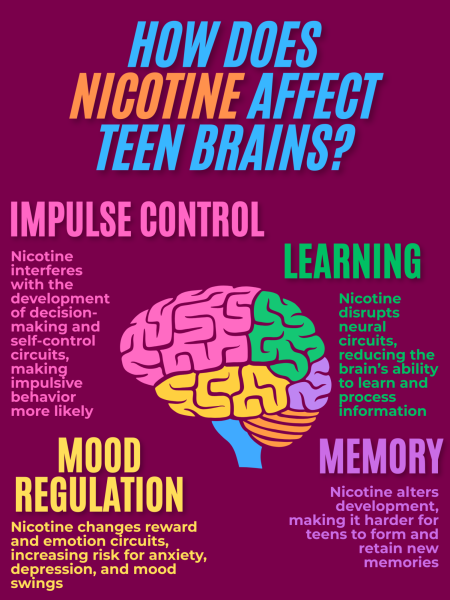
Quitting poses obstacles for teenagers struggling with nicotine addiction. According to Thompson and Budnitz, withdrawal symptoms, such as mood swings, irritability, headaches, anxiety and trouble focusing can make “school, friendships and daily life more stressful.”
“Nicotine addiction is not a ‘phase,’ and it’s more like a chronic disease,” Thompson said. “Quitting can be really hard. For many teens, that stress can drive them back to vaping. That’s why prevention is so important. With the right support, quitting is absolutely possible, though difficult.”
*The source’s name was changed to protect their identity and privacy